Showing posts with label pictures of moorhens. Show all posts

Friday, 16 January 2015

Nesting Moorhens

Pictures of birds: Nesting Moorhens

female moorhen
female moorhen in tree
Birdwatching is a delight and never more so that when birds are nesting. This photo journal by wildlife photographer AnnMackieMiller documents one moorhen's nest along the Leeds to Liverpool canal.
Moorhens are great climbers so it was no surprise to find them nesting in a tree - they like to keep the nest hidden away from predators like mink and, in the water, pike. What was more surprising was the demonstration of ingenuity in how they pulled down a branch to get a start up the tree to the nest.

How to spot a moorhen's nest


adult moorhen with reeds
adult moorhen carrying nesting material
Moorhens nests can be hard to spot, especially once trees and shrubs take on new growth as Spring advances. Mostly you spot them by watching for both adults taking nesting materials into the nest.
Both adult moorhens are responsible for nest-building and they are very keen and very meticulous in their duty. The rule they seem to live by is 'never go back to the nest empty-beaked'. This gives the birder the ideal opportunity to see where the nest is hidden. Before eggs are laid you will see both adults out of the nest and carrying nesting material back.
Once eggs have been laid, the nest it is never left unattended. The adults take shifts in going off to feed and to forage for likely nesting material and then do a shift change - one off, one on. When the chicks hatch out, you will see the adults taking food back to the nest. It is often handed over to the sitting moorhen to pass onto the chicks but the carrier will feed the young ones too. .. and still the nest building continues.

Information on Moorhens

Moorhens are delightful little birds often seen on local ponds and rivers. They have long yellow legs and splayed toes which are ideal for climbing and for negotiating reeds and boggy vegetation that is their favourite habitat. They belong to the rail family.
Adult moorhens can be describes as plumb dark coloured birds. They are roughly the size of a pigeon but with much longer legs. Generally they are slate grey (gray) with brown feathering. They have a paled undercarriage - the female's paler than the males. They also have white strips down their sides and white under-feathers on the tail. They use these for displaying and for aggressive poses. They will also bob their white underfeathers when they are trying to lure danger away from their young.
They are most distinctive for the red frontal shield and bill that ends in a yellow tip. These charismatic creatures swim with a forward bob of the head.
It was fascinating to watch this pair of moorhens. Like most they like to hide the nest high in trees and bushes and they are adept climbers.
Once I spotted an adult plucking nesting material from the bank, it was an easy matter to follow it down stream to the nest site.
Once it got there, the branch was a bit above the water but this is no problem - the bird used his big feet to pull the branch down to a level where he could begin to climb. Those feet did the rest. He had no sooner disappeared into the canopy, the female appeared on her way out to forage.
male moorhen with tree
Male Moorhen
'First you have to pull the branch down to water level...'


moorhen with nesting material
Moorhen 'then you use.big feet to scramble up branches ...'

moorhen in tree
moorhen ' ...and wings are essential for balance.'

adult moorhen climbing into tree
Adult moorhen climbing into tree

adult moorhen climbing tree

female moorhen
a quick change and the female leaves the nest - moorhen

female adult moorhen
female adult moorhen in tree

female adult moorhen in tree
female moorhen in tree

Monday, 8 December 2014

Micklethwaite Moorhens With New Chicks: One Day Old Moorhen Chicks

The First Moorhen Chicks on Bingley Canal: One Day Old Moorhen Chicks in the Nest
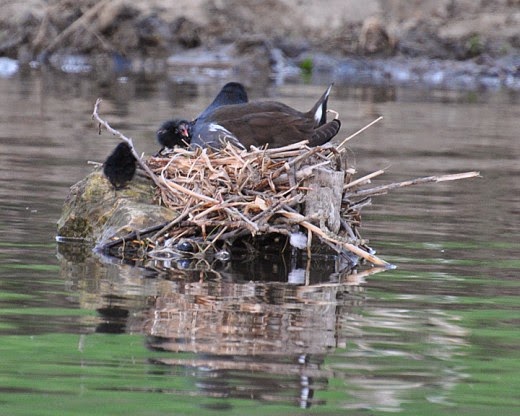
adult moorhens and nest
Moorhen nest, two adult moorhens

On 17th April the behavour of the moorhens that are nesting at Micklethwaite Wharf near Bingley, West Yorkshire, changed. These fiesty little birds had been observed carrying nesting material - Moorhens are compulsive nest-builders. Now, however, they were also carrying food. This feeding behaviour is typical of moorhens and signals the arrival of the first chicks. Before the eggs hatch, adults are happy to feed themselves away from the nest and simply do 'shift changes' where one adult goes to the nest to sit on the eggs when the other leaves to feed. Once you see a moorhen carrying food and offering it to the adult on the nest, you can be sure there are chicks there. All you need do is be patient and wait for the little heads to appear.


moorhen and moorhen chicks in the nest
adult moorhen with one-day old moorhen chicks in the nest


Watching moorhens

I am really lucky to be able to observe there moorhens up close and personal. For reasons known only to themselves they have chosen to build a nest on a stone out into the canal. Perhaps it is safer from predators. It is some distance from the bank where the tow path runs so they are relatively safe, except for wandering cows but that is a different story.
It does make it easy to monitor them daily and it is just wonderful to be able to see bird behaviour that would otherwise be hidden away in bushes and trees.
The moorhens come back to the same mate and the same territory every year. The nest is a messy affair but they are nothing if not enterprising in what they take to fill and line it.
adult moorhen carrying nesting material

adult moorhen on nest with chicks
moorhen chick climbing into nest

Information about moorhen chicks

  1. Moorhen chicks hatch after around 20-21 days.
  2. Despite having what look like bug eyes, the moorhen chicks are born able to see.
  3. They have what look like red and yellow beaks and a bald reddish patch on the top of their head. Often the only way to count how many there are in the nest, is to count the red spots. On the 17th five red bits could be seen.
  4. Moorhen chicks are fed and brooded by both parents.
  5. The chicks spend only the first day confined to the nest although some are more adventurous. In this particular brood two kept falling out of the nest on the first evening but with huge black feet they had no problem regaining the nest.
  6. After the first day, you can see them out of the nest on the nearest shore with one or other of the adults.
  7. Moorhen chicks are fed by the adults for around 6 weeks after they hatch although they do graze some for themselves.
  8. They are excellent climbers - those big feet come in handy right from the start and they will clamber up anything.
  9. The adults can have 2 or 3 broods a year and the juvenile chicks from early broods help to look after later broods.
  10. As they approach adulthood, the juveniles are taken on a journey by the female to explore new territories.

adult moorhen with chicks in nest

adult moorhen with chicks in nest

Moorhen Facts - Geek Stuff

Order: Gruiformes
Family: Rallidae
Species: Gallinual chloropus
Common Name: Moorhen
The moorhen is a small water bird belonging to the raill family. They are a common sight on most ponds, rivers and lakes. It is a greyish/black bird, about the size of a pigeon, with glossy brown underbelly. Most noticeable is the red shield on the forehead and beak and yellow tip. The genders are very similar especially seen at a distance, but the female has a paler undercarriage. In addition her beak is slightly slimmer and longer than the male's.
They appear fairly shy birds, skittering away over water to find cover and their long legs and feet are ideal for traversing boggy ground and getting through vegetation. They are, however, quiet fiesty birds and will take on intruders much larger than themselves when they are nesting or caring for young. I once watched one take on a flamingo at Martin Mere when it strayed too close to the nest.
They make diligent parents, feeding the young with great delicacy.
I hope you come back to share more of my moorhen piccies.