Showing posts with label pictures of birds. Show all posts

Friday, 17 April 2015

Hard at Work Starling

Starling photos at Upton

starling on bird feeder
starling trying to figure out how to get to the fat balls in the feeder

This little lad looked a bit disgusted that he had to work hard to reach the fat balls on the feeder. Just shows how handy that long beak is.

Starlings are surprisingly beautiful birds - just look at those luminescent feathers!

They tend to get a bad press. They are a bit noisy and they like to go around in flocks. They are particularly good to watch at Upton Cottage with young families when they fledge. They nest at the house which gives us a great chance to see them.

starling on bird feeder
"it WILL be mine!"
starling on bird feeder
'fluttering' starling on bird feeder


starling on bird feeder

starling on bird feeder
'Triumphant!' starling on bird feeder

Friday, 12 December 2014

A Bird's Eye View of a Dunlin

Pictures of British Birds: A Bird's Eye View of a Dunlin 

male dunlin
Dunlin
 This photo journal features a close-up view of a pretty little Dunlin that allowed me to get up close and personal.
"Dunlins are waders, shorebirds usually seen on shorelines at low tide. So you would expect to see a dunlin when visiting the coast. However, you would not necessarily expect to see a dunlin on a path on top of a 300 foot high cliff. It was with great delight this birdwatcher (plus camera) found this pretty dunlin foraging in a muddy puddle on a public footpath at RSPB Bempton Cliffs Yorkshire. It came very close, indeed, at times too close for the camera to focus properly. What a privilege to be able to document that encounter in this photo journal together with some information on dunlins that you may enjoy."


Information about Dunlins: Geek Stuff

young male Dunlin
Dunlin
  • Order: Charadriformes
  • Family: Scolopacidae
  • Species: Caldris alpina
  • Found: Europe
  • Length: 16-20cm or 6-8 inches
  • Wingspan: 35040cm or 14-16 inches
  • Weight: 40-50gram or 1-2 ounces
  • Lifespan: up to 10 year
  • Migratory: some winter in UK, others migrate to the Mediterranean and the Middle East
  • Breeds: Coastal Europe, UK, Scandanavia and Iceland.
  • Nesting: Ground nesting in small, shallow nest lined with grasses.
  • Eggs: 3-4 - lays only one clutch per year around May, June or July.
male dunlin
male Dunlin

How to identify a Dunlin

Size-wise, the dunlin is a little smaller than a starling. It is a vey pretty little wading bird usually seen along a shoreline at low tides. It is particularly fond of tidal estuaries and mudflats but can also be found in any marshy habitat.
The adults have a rich chestnut and black back and a buff chest that has a light and dark streaking that gives it an attractive speckled appearance. The lower belly is black but in the female this is lighter and smaller than in the male. They have long legs and splayed feet that are their wetland habitat. The small head has a chestnut patch with a paler eyebrow line and a dark eye. Typically, they have a long, narrow beak (smaller in the female than the male) that allows them to dig down into mud for worms, insects and other invertibrates.
Juveniles are paler with black and cream strips on their backs. Typically, the adult plumage changes in winter when the adult appears with a much paler chestnute with a grey-streaked chest - the black on the lower belly disappears in winter.

What do Dunlins eat?

Dunlin foraging for invertibrates in the mud
Dunlins eat worms, insects, insect larvae and other invertebrates and ocasionally seeds. They use that long beak to probe deep into mud in search of molluscs. The photographs displayed here give an excellent illustration of that.

Dunlin foraging in the mud

Dunlin foraging in the mud

Square Magnet: Dunlin
Square Magnet: Dunlin by annmackiemiller
View Birds Magnets online at zazzle

PHOTO GALLERY OF A DUNLIN
young male Dunlin
young male Dunlin

young male Dunlin
young male Dunlin

young male Dunlin
young male Dunlin

young male Dunlin
young male Dunlin


young male Dunlin
young male Dunlin

young male Dunlin

young male Dunlin
young male Dunlin


Monday, 8 December 2014

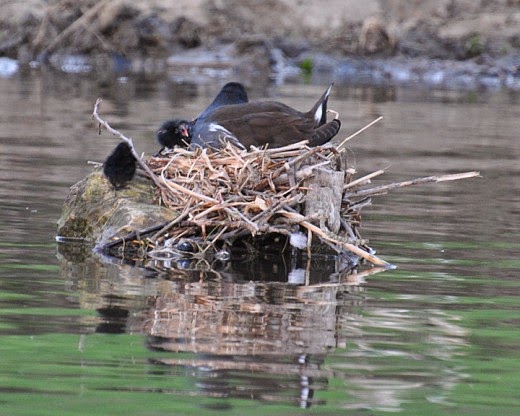
Micklethwaite Moorhens With New Chicks: One Day Old Moorhen Chicks

The First Moorhen Chicks on Bingley Canal: One Day Old Moorhen Chicks in the Nest
adult moorhens and nest
Moorhen nest, two adult moorhens

On 17th April the behavour of the moorhens that are nesting at Micklethwaite Wharf near Bingley, West Yorkshire, changed. These fiesty little birds had been observed carrying nesting material - Moorhens are compulsive nest-builders. Now, however, they were also carrying food. This feeding behaviour is typical of moorhens and signals the arrival of the first chicks. Before the eggs hatch, adults are happy to feed themselves away from the nest and simply do 'shift changes' where one adult goes to the nest to sit on the eggs when the other leaves to feed. Once you see a moorhen carrying food and offering it to the adult on the nest, you can be sure there are chicks there. All you need do is be patient and wait for the little heads to appear.


moorhen and moorhen chicks in the nest
adult moorhen with one-day old moorhen chicks in the nest


Watching moorhens

I am really lucky to be able to observe there moorhens up close and personal. For reasons known only to themselves they have chosen to build a nest on a stone out into the canal. Perhaps it is safer from predators. It is some distance from the bank where the tow path runs so they are relatively safe, except for wandering cows but that is a different story.
It does make it easy to monitor them daily and it is just wonderful to be able to see bird behaviour that would otherwise be hidden away in bushes and trees.
The moorhens come back to the same mate and the same territory every year. The nest is a messy affair but they are nothing if not enterprising in what they take to fill and line it.
adult moorhen carrying nesting material

adult moorhen on nest with chicks
moorhen chick climbing into nest

Information about moorhen chicks

  1. Moorhen chicks hatch after around 20-21 days.
  2. Despite having what look like bug eyes, the moorhen chicks are born able to see.
  3. They have what look like red and yellow beaks and a bald reddish patch on the top of their head. Often the only way to count how many there are in the nest, is to count the red spots. On the 17th five red bits could be seen.
  4. Moorhen chicks are fed and brooded by both parents.
  5. The chicks spend only the first day confined to the nest although some are more adventurous. In this particular brood two kept falling out of the nest on the first evening but with huge black feet they had no problem regaining the nest.
  6. After the first day, you can see them out of the nest on the nearest shore with one or other of the adults.
  7. Moorhen chicks are fed by the adults for around 6 weeks after they hatch although they do graze some for themselves.
  8. They are excellent climbers - those big feet come in handy right from the start and they will clamber up anything.
  9. The adults can have 2 or 3 broods a year and the juvenile chicks from early broods help to look after later broods.
  10. As they approach adulthood, the juveniles are taken on a journey by the female to explore new territories.

adult moorhen with chicks in nest

adult moorhen with chicks in nest

Moorhen Facts - Geek Stuff

Order: Gruiformes
Family: Rallidae
Species: Gallinual chloropus
Common Name: Moorhen
The moorhen is a small water bird belonging to the raill family. They are a common sight on most ponds, rivers and lakes. It is a greyish/black bird, about the size of a pigeon, with glossy brown underbelly. Most noticeable is the red shield on the forehead and beak and yellow tip. The genders are very similar especially seen at a distance, but the female has a paler undercarriage. In addition her beak is slightly slimmer and longer than the male's.
They appear fairly shy birds, skittering away over water to find cover and their long legs and feet are ideal for traversing boggy ground and getting through vegetation. They are, however, quiet fiesty birds and will take on intruders much larger than themselves when they are nesting or caring for young. I once watched one take on a flamingo at Martin Mere when it strayed too close to the nest.
They make diligent parents, feeding the young with great delicacy.
I hope you come back to share more of my moorhen piccies.


Saturday, 6 September 2014

Birds on Bright Water

duck on moving water
Bird of Bright Water by annmackiemiller
Duck on moving water

Birds on Bright Water


As you know I love waterfowl but as often as not I feel as if I am photographing the water. I love to see the different effects of light, reflections and movement that make backgrounds to my photos. I'm experimenting with putting a few together on video - Tell me what you think?


canada goose on water
Canada goose on water by annmackiemiller

moorhen on water
moorhen on water by annmackiemiller


Monday, 19 September 2011

New fine art by AnnMackieMiller

Hi, one of the reasons I haven't been photographing along the canal much recently is because they have been dredging it - result - muddy water. And - I feel the effects of light on water are as much a part of my photos as the birds themselves. I love the way it changes and the colours and patterns that result. So you can imagine how delighted I was when Zazzle started creating Wrapped Canvas prints. These are ideal for me - the wrap around print gives a great 3D effect and the water comes into its own. I've called this series Wildlife and Water and these are some of the prints.
http://annmackiemiller.hubpages.com/hub/Fine-Art-Photography-by-AnnMackieMiller