Showing posts with label nesting geese. Show all posts

Saturday, 13 December 2014

Bird Behaviour: Three Geese - One Nest

Nesting Geese: Three to a nest and the little one said...

embden and toulous geese
three geese one nest
This is rarely seen goose behavour - here I document a goosy threesome, with the beta female laying eggs while the alpha female and male supervise.  Some of the pictures aren't great but well worth viewing. You rarely get a chance to witness an episode like this. I was lucky enough to be there just as the grey goose, the beta female was ready to lay her eggs much to the disgust of the other two. Once the eggs were laid though the alpha female was left triumphantly in charge of all their eggs. 
Near Bingley in West Yorkshire domestic geese have gone wild and now form a flock of about 60 birds. On a stretch of the Leeds to Liverpool canal, there are at least ten (10) goose nests within sight of the footpath on the opposite bank of the canal. This offers a unique opportunity for observing bird behaviour during the breeding season. This is a photo-journal of one of the two goose nests that have been observed as being used by two females and their mate.
This nest is nestled under an ancient hawthorn tree, the nest hollowed out amid the debris of an old dry-stone wall. The first nester was a pure white embden goose mated to a large white embden. The third in the party has some toulous goose blood so for convenience she is referred to as the grey goose. Officially they are ALL grey or gray geese but it is easier to describe them as white or grey for convenience. She is obviously the beta female in the threesome.
The white female laid her eggs around the 17th March. Unfortunately the nest was well enough hidden that the number of eggs could not be counted. Then, on the 29th March, the grey female laid eggs in the same nest. It remains to be seen if all the eggs hatch and when. Goose eggs incubate for 30-34 days.
This is the story of a sunny afternoon spent watching the behaviour of feral geese. Over about half an hour, the story unfolded.

The three geese involved had been seen together before which suggests they were mated. It is not unusual for geese to form threesomes which I have documented elsewhere. In this case there are two females and one male. As the act of mating was not witnessed it is impossible to say for certain the male had impregnated both females, but given that geese do not tolerate other geese near them at this time of year, except for mates, it is suggestive that he had. This was confirmed when the grey goose laid eggs in the same nest where the white female had been sitting on eggs since mid March.
nesting geese
The grey female plucked down from her undercarriage to further line the nest.
Source: Photography by AnnMackieMiller copyright 2011
It was evident the grey female goose was ready to lay eggs when she displayed nesting behavour: she plucked grass and twigs and threw them over her shoulder to build up the nest. When the white geese moved off toward the canal to feed, she sat on the nest and pulled the nesting material around herself. The white pair came back and in this instance got her off the nest. Lots of noisy interaction later, the white pair moved off up the field.
Now the grey goose pulled down from her undercarriage to further line the nest and started laying.
Spooked by a flock of crows coming down toward the nest, the white pair gave alarm calls and came running back down the field to the nest to find the grey goose installed.
With much haggling the large male stood on the back of the grey female, I think trying to get her off. It certainly was not mating with her for three reasons: a) they normally mate on water, b) mating is usually over in seconds, while he stayed on top of her for almost 10 minutes, c) after mating male geese cannot help displaying and crowing about it to everything within two miles.
The white female tried to hook the eggs under herself where she had settled on one edge of the nest. At this point the grey goose got up and literally dropped her last egg. When she moved off the white female took back central position and spend some time gathering all the eggs together underneath her.
nesting geese
The white geese decided to go off up the field leaving the grey goose at the nest.
Source: Photography by AnnMackieMiller copyright 2011


nesting geese
When a flock of crows headed towards the nest, the white pair came tearing down the field to it.

nesting geese
This time the grey goose wasn't moving, she had started to lay eggs.

A word about the wildlife photographs

Some of the photographs show camera shake as they were taken at some distance and hand held. Camera used, Nikon D90 with Nikon 70mm-300mm lens.
All the photographs used on this and other webpages are low resolution to prevent theft. High resolution electronic copies are available for a small fee for use on websites and blogs, NOT on products, these are reserved for my own use.
Contact me for more information.

PHOTO GALLERY WILD NESTING GEESE


Grey goose exhibits nesting behaviour, seen when females are about to lay eggs.

She takes advantage of the white geese feeding in the canal to make her takeover bid.


The white female comes back from the canal and persuades the grey female to move

The grey female continues to bring nesting material to the nest while the white female is sitting on her eggs.

The white male tries to move the grey one by standing on her back.

She was NOT moving

The white female tries to get to the eggs.


The male gives up while the white females tries to get on.

The white female and grey female side by side. The grey goose is still laying eggs.

The white female trying to collect the eggs under herself.

Male goose standing guard

The grey goose drops her last egg just on the edge of the nest.

The grey goose moves off while the white goose gathers the eggs together.

The one that almost got away but didn't

Triumphant the alpha female is left in charge.

Come back and visit and meet the only gosling that successfully hatched from this nest. 

Wednesday, 10 December 2014

How Geese Nest in the Wild: Domestic Geese Gone Wild

Domestic Geese Gone Wild

white embden goose
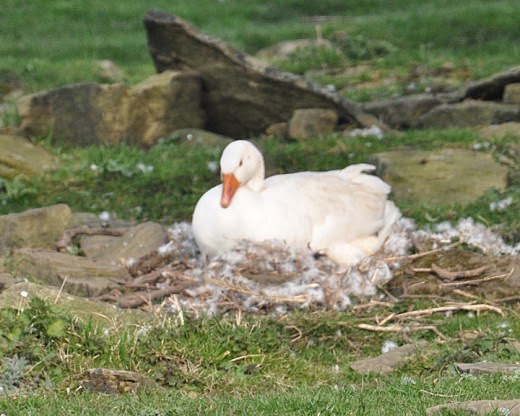
Embden Goose on nest
Near Micklethwaite Wharf on the Leeds to Liverpool canal, in Yorkshire, England, a flock of geese flourish. The original geese were white (gray) domestic geese that escaped from local allotments. Over the years the flock has grown and now numbers about 60 birds. Last year there were only five (5) live goslings born on what locals call the Greenhill.
Interestingly, this year, the flock has split in two. Half stay on the Greenhill while the rest have taken over a field further up the canal. This field is not far from their original site. What is heartening is that there are a lot more nest being built along the canal this year.
In sight of the tow path, the footpath that runs along the opposite bank of the canal from the geese, there are at least ten (10) nests. Only one is obvious on the Greenhill having been built under an ancient hawthorn tree. This is not to say there are not other nests out of sight.
The remainder spread along the side of the canal from the swing bridge at Micklethwaite Wharf to a small weir (an old run-off) about a mile away.
The presence and proximity of the nests provide a unique opportunity to observe nesting behaviour of domestic geese gone wild.
All the images used here on this photo journal are by AnnMackieMiller and are copyright 2011.

A Typical Goose Nest 

nesting Embden goose
Geese are not particularly skilled nest builders. Before laying, the hen will scratch out a hollow, usually near water since the goslings need to get to water soon after birth. The nest is basically the shape and size of her underbelly and she lines it with down plucked from her under carriage. Hence the large amount of down you see floating around the areas where geese nest. Something gratefully harvested by smaller birds for nesting material.
nesting Embden goose

nesting Embden goose
After she lays the eggs, which she does while the gander keeps guard, she will build up the nest with twigs and grass around her. Typically you see them picking the material up, throwing it over their back then sitting on the nest and gathering it around them. Presumably this is for further protection and containment for the eggs and young chicks when they hatch.

How to spot a goose about to lay eggs

  
male goose guards female on the nest

Nesting behaviour becomes evident when the female is ready to lay her eggs. The male takes no part in the nest building or indeed of sitting on the eggs. His role is limited to protection: the male will stand guard while she is laying and will chase off all comers who come near.
What you will notice first is the hen picking up grass and twigs and throwing them over her back, almost in a circle. She will then squat down, creating a hollow and pull the debris around her. After this she will pluck down from her underbelly to line the nest. 
She will then make a lot of noise to get the male to come stand guard if he isn't already there - they are noisy characters. 
male goose guards female on the nest

male goose guards female on the nest
"Just Checking"!

A note about the geese n Greenhill

 Most of the geese here are Embden geese, white domestic geese of the 'grey' goose family.   In the flock there are also Toulous geese, which have more brown in them and are much larger.  Over time there has been much cross-breeding between these two types of domestic geese as well as wild geese.  Several show signs of having greylag in their DNA. I believe there are also some Toulous Geese and at least one China Goose.  It all makes for some very interesting combinations of colours and feathers and makes it even more exciting to watch for the new goslings.

The first goose nest

Embden Goose with Eggs
The first eggs to be laid this year were along near the weir, under a tree. The parents were two pure white Embden geese, the gander standing guard and nipping at her neck and 'encouraging' her every time she laid an egg. They were laid on the 14th March 2011 in a rather precarious position right on the bank. Indeed, one egg almost landed in the canal.
The next day it became evident that these two were actually part of a threesome, something that is not uncommon and which I have documented elsewhere. The 'third' was a pretty little grey companion that clearly had greylag ancestory. The first clue that they were a threesome was when the male came down to the nest when called by the female. They graze in a field high above the canal and one could clearly hear him answering to each of the female's calls as well as being able to see him racing along the field to get down. With him came the grey companion.
Embden Goose with Eggs

Embden Goose with Eggs
Embden Goose on nest with eggs

Embden Goose with Eggs
Embden Goose on nest
Since then I have seen all three together and seen the male and little grey companion in several 'greeting' displays. The little grey goose turned out to be female, but that is a story for another day.
In total she laid nine (9) eggs that day.  The next day she had clearly recovered the wayward egg and appeared diligent in sitting on them and in turning them.
Unfortunately, since then, this nest has not been well attended.   All three geese continue to protect it by chasing away everything that comes near, but neither of the females is sitting on the eggs much.  It is unlikely any of the eggs will hatch given that they have been left exposed too often and too long.  Perhaps this was their first breeding season and this is simply inexperience.
In actually fact, these eggs never hatched. 

PHOTO GALLERY OF WILD GEESE NESTING