Showing posts with label baby birds. Show all posts

Thursday, 1 January 2015

Pictures of Little Goslings

 baby geese

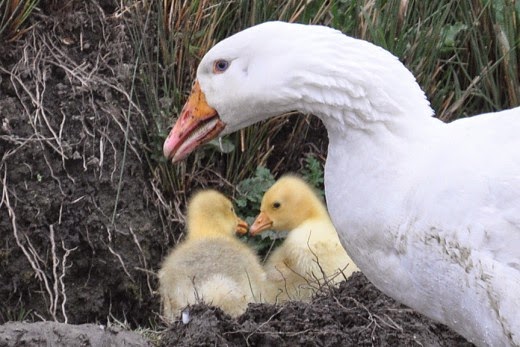
Embden geese and goslings
Embden Geese Goslings
This photo journal features some very new goslings. Wildlife photographer AnnMackieMiller lets the baby geese tell their own story in this light-hearted article.
There is such a lot to learn when you are fresh out of the egg.
Lesson number one: Stick close to Mum ... or Dad, preferably both!
Goslings are born able to feed themselves but sometimes it takes a bit of practice. This lot seemed to handle themselves fine, if a little enthusiatically at times.
Then you have to learn how to get out of trouble, how to get along with your brother and sisters and how to get Mum to let you snuggle.
It's all hard work for a gosling.

Learning how to graze

goslings with adult
'Opps' Tugged too hard there
Clue to perfect grazing:
Embden Don't tug on the grass too hard or you end up on your bottom.
  1. Take a GOOD look. 
    Embden gosling grazing
    Close inspection needed'

    Learning to duck and dive

    Embden goose and goslings
    Trouble? Dive, dive, dive
    At the first hint of trouble - duck and dive.
    The first day out on the canal and it is a scary place. Goslings and ducklings both learn to dive their way out of trouble where ever they can. Adult geese also use ducking under the water to escape.
    The little one in the picture was spooked by another adult goose.

gosling under water
"I'm going under..."
I'll just stay behind Mum
Embden gosling on canal
Safe

Learning to spead the love

We may fight a lot but we still love each other.
Geese show affection to each other. As adults it tends to be very loud, with goslings, not so much.
Adult Embden goose with two goslings
"now now children, no fighting"

Adult Embden goose with two goslings

Adult Embden goose with two goslings

Adult Embden goose with two goslings
"I luvs ya really."

Learning to snuggle

Don't be afraid to show what you want. When there is a cold wind blowing and your tummy is full, what better spot than under Mum's wing?
These day old goslings are looking for some heat under Mum while Dad keeps watch for baddies.
adult Embden geese with chicks
"Let me in Mum"

Adult Embden geese with goslings
"It's cold out here."

Adult Embden geese with goslings brooding
"Snuggle time."

Information about these geese

These are part of a large flock of domestic geese gone wild living onGreenhill. Mostly they are white Embden geese but there are also Toulous geese who have more grey feathering. There is also a mix of both with some greylag goose thrown in. One Canada goose was seen mating with a white male but this is unusual and it remains to be seen if there are any goslings as a result.
The female of this partnership is pure white while the male has grey feathering on his wings. If you look at the goslings, you will notice they have some dark patches among the yellow. These are likely to turn into grey markings when they are fully grown.
The all-white geese are harder to identify but with observation you can notice differences in beak markings and the hue of their legs, some can be very pale. The females are all considerably smaller than the males.


Friday, 19 December 2014

Goslings on Bingley Canal

Pictures of Geese: Greenhill Goslings

goose and goslings
Embden Goose with Goslings
This photo journal documents the appearance of the first goslings born along Bingley canal in 2011. These original pictures are particularly endearing and are coupled with information on geese you may not know.

Five tiny balls of fluff on legs have appeared on Greenhill, Bingley. Surprisingly not from any of the nests that have been under observation, so this one must have been well hidden.
This photo journal documents the first appearance of the first goslings born along Bingley canal in 2011. These original pictures are particularly endearing and are coupled with information on geese you may not know. Five tiny balls of fluff on legs have appeared on Greenhill, Bingley. Surprisingly not from any of the nests that have been under observation, so this one must have been well hidden.
It may seem the wrong time of year to be sharing pictures of baby birds but I have method in my madness. First of all I am moving content away from Hubpages and probably more importantly I am rasing money to feed the Greenhill Geese over the winter - something I do every year. They do get fed a lot by visitors with bread but bread actually has no nutritional value for birds and they cannot digest it properly so I buy grain so for then. It's expensive! So if you can help even with £1 or $1 and if you enjoy my pictures go to my FundRazr page --> Feed Greenhill Geese.

Adult Embden Geese with Goslings
It is interesting to note that while only the female sits on the nest, and often the male is nowhere to be seen, now the goslings are here, both parents are diligent in their protection. Indeed, it has been noted that the males seem to know when the eggs are about to hatch. The adults do not feed the young, they are born able to feed themselves. They are, however, responsible for their safety.
Unlike mallard ducklings that tend to busily flit around quite far from their mother, the goslings stay very close to the parents, often right in between them. On land, where they graze most, the male is usually standing guard while the female sits and the goslings graze. Then while the male feeds the female will stand guard.

Adult Embden Geese and Goslings on Bingley Canal
These baby birds are only one or at the most two days old. Once they hatch they are immediately led to water in our case the canal . 

Copyright notice

All the images used here are taken by AnnMackieMiller, copyright 2011.
The wildlife photographs are displayed here as low resolution - that means they look blurred when blown up - to discourage theft. However, high resolution electronic copies are available for sale for use on websites and blogs - NOT for use on products - that is retained for the author's own use.

Embden Geese Goslings on Bingley Canal
Goslings

Embden Geese Goslings on Bingley Canal
If you are interested in any of these or any other bird images, please feel free to contact me.


PHOTO GALLERY EMBDEN GEESE WITH DAY OLD GOSLINGS

Adult Embden Geese and Goslings on Bingley Canal
There is always at least one adult on watch

Adult Embden Geese and Goslings on Bingley Canal
Keeping watch as moorhen looks on

Adult Embden Geese and Goslings on Bingley Canal
A quick nips gets one moving

Adult Embden Geese and Goslings on Bingley Canal
One, Two, Three, Four ... there's one missing ...

Adult Embden Geese and Goslings on Bingley Canal
"I'll clear the way love,"


Saving Greenhill

Greenhilll Micklethwaite Wharf
Greenhill Site
Greenhill is a 40 acre green field site at Micklethwaite Wharf, on the Leeds to Liverpool canal, near Bingley in West Yorkshire. It is home to a resident flock of about 70 white/grey geese who have gone wild and bred here.  In addition there are dozens of mallard ducks, Swedish geese, whie domestic ducks, moorhens, swans, Canada geese and visiting greylag geese. The ancient hedgerows are important navigation for rare continental bats that roost in the area. With easy visual access to this site from the tow path on the other side of the canal, it is a favourite of every generation who come to watch the antics, to listen to the squabbling geese and to feed them.
It is where I do most of my goose photography and it is under threat. A private developer want to put 400 houses on the site and Greenhill Action Group are fighting the planning application. As usual the developers have the upper hand and are using all the tricks at their disposal to get planning permission to destroy this peaceful place.


Monday, 8 December 2014

Micklethwaite Moorhens With New Chicks: One Day Old Moorhen Chicks

The First Moorhen Chicks on Bingley Canal: One Day Old Moorhen Chicks in the Nest
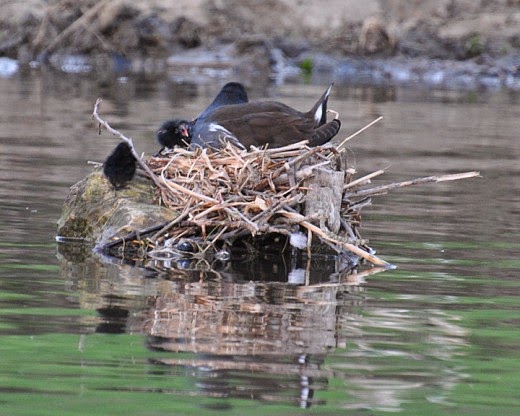
adult moorhens and nest
Moorhen nest, two adult moorhens

On 17th April the behavour of the moorhens that are nesting at Micklethwaite Wharf near Bingley, West Yorkshire, changed. These fiesty little birds had been observed carrying nesting material - Moorhens are compulsive nest-builders. Now, however, they were also carrying food. This feeding behaviour is typical of moorhens and signals the arrival of the first chicks. Before the eggs hatch, adults are happy to feed themselves away from the nest and simply do 'shift changes' where one adult goes to the nest to sit on the eggs when the other leaves to feed. Once you see a moorhen carrying food and offering it to the adult on the nest, you can be sure there are chicks there. All you need do is be patient and wait for the little heads to appear.


moorhen and moorhen chicks in the nest
adult moorhen with one-day old moorhen chicks in the nest


Watching moorhens

I am really lucky to be able to observe there moorhens up close and personal. For reasons known only to themselves they have chosen to build a nest on a stone out into the canal. Perhaps it is safer from predators. It is some distance from the bank where the tow path runs so they are relatively safe, except for wandering cows but that is a different story.
It does make it easy to monitor them daily and it is just wonderful to be able to see bird behaviour that would otherwise be hidden away in bushes and trees.
The moorhens come back to the same mate and the same territory every year. The nest is a messy affair but they are nothing if not enterprising in what they take to fill and line it.
adult moorhen carrying nesting material

adult moorhen on nest with chicks
moorhen chick climbing into nest

Information about moorhen chicks

  1. Moorhen chicks hatch after around 20-21 days.
  2. Despite having what look like bug eyes, the moorhen chicks are born able to see.
  3. They have what look like red and yellow beaks and a bald reddish patch on the top of their head. Often the only way to count how many there are in the nest, is to count the red spots. On the 17th five red bits could be seen.
  4. Moorhen chicks are fed and brooded by both parents.
  5. The chicks spend only the first day confined to the nest although some are more adventurous. In this particular brood two kept falling out of the nest on the first evening but with huge black feet they had no problem regaining the nest.
  6. After the first day, you can see them out of the nest on the nearest shore with one or other of the adults.
  7. Moorhen chicks are fed by the adults for around 6 weeks after they hatch although they do graze some for themselves.
  8. They are excellent climbers - those big feet come in handy right from the start and they will clamber up anything.
  9. The adults can have 2 or 3 broods a year and the juvenile chicks from early broods help to look after later broods.
  10. As they approach adulthood, the juveniles are taken on a journey by the female to explore new territories.

adult moorhen with chicks in nest

adult moorhen with chicks in nest

Moorhen Facts - Geek Stuff

Order: Gruiformes
Family: Rallidae
Species: Gallinual chloropus
Common Name: Moorhen
The moorhen is a small water bird belonging to the raill family. They are a common sight on most ponds, rivers and lakes. It is a greyish/black bird, about the size of a pigeon, with glossy brown underbelly. Most noticeable is the red shield on the forehead and beak and yellow tip. The genders are very similar especially seen at a distance, but the female has a paler undercarriage. In addition her beak is slightly slimmer and longer than the male's.
They appear fairly shy birds, skittering away over water to find cover and their long legs and feet are ideal for traversing boggy ground and getting through vegetation. They are, however, quiet fiesty birds and will take on intruders much larger than themselves when they are nesting or caring for young. I once watched one take on a flamingo at Martin Mere when it strayed too close to the nest.
They make diligent parents, feeding the young with great delicacy.
I hope you come back to share more of my moorhen piccies.


Tuesday, 16 September 2014

Birdwatching along Bingley Canal

Along the canal - my 6 feathered families


white mallard duck
'what ya doing?" white mallard duck by annmackiemiller
This page takes a look back at the "Fowl Tales", a collection of photo journals featuring British birds taken by me here in Yorkshire. I particularly love wildfowl. These are all photographs of my favourite families taken last year on a small stretch of the Leeds to Liverpool canal, near Bingley, West Yorkshire, England. This is also something of an anticipatory lens, I can't wait to see what I find to photograph every year.

Some people feel the need to travel to exotic locations to photograph birds, but there is plenty to see and learn around your own neighbourhood. All you need is a camera, a notebook and a willingness to venture out in all weathers. Personally, I love to be able to tell a story with my pictures and there is no better way to do that than by observing the birds day by day. I hope you enjoy sharing my journey.

6 Wildfowl Families Along Bingley Canal

There were several waterfowl families that captured my imagination last year.

In their pecking order:
  • Grumps and Lady: mute swans who had seven cygnets
  • The Canada Geese who had seven goslings
  • Greenhill Geese: White domestic geese with only four goslings
  • Mama Mallard: a golden-coloured mallard duck who produced 15 ducklings
  • Smudge the white mallard duck
  • Micklethwaite Moorhens: a mating pair of moorhens at Micklethwaite Wharf who produced two broods

Mute Swans

mute swans with cygnets
mute swans with cygnets by annmackiemiller
Two mute swans have been breeding at this site for many years. Lady is his second mate after his first mate was killed by foxes. Grumps is probably about 17 years old and definitely believes he rules the canal. He regularly chases everything off the canal, he seems to particularly hate the Canada Geese.
cygnets
7 mute swan cygnets
female mute swan and cygnets
'Lady' the mute swan with cygnets by annmackiemiller
Swans mate for life, Grumps' first mate died and this is his new love called Lady. They had seven cygnets.

Canada Geese

Canada Geese
Canada Geese and Goslings by annmackiemiller
Parents keep watch as the goslings feed
 Of the six visiting Canada geese on our Greenhill, there was one mating pair. They produced seven goslings who all survived. They tend to be quite aggressive but can’t stand up to the mute swan. One day in particular Grumps kept them penned in on the wooden workings of the swing bridge.


The folk who own the flats alongside the canal were fortunate to have these little gardeners keeping the grass short.

Canada geese and goslings on water
'On the water' Adult Canada goose with goslings on water

Canada geese goslings
'Keeping it together' Canada Geese Goslings

Greenhill Geese: Embden Geese


Embden geese with chicks
'That tickles!' Embden geese with goslings
We have a resident flock of geese who live on our Greenhill- actually it is four small flocks. They are mainly white domestic geese, combining Emden and Toulouse geese, a single China goose and some hybrids that have mated with greylag geese. The gaggle started as escapees from local allotments, now gone wild. At their most there were 70. Of these only four goslings were born last year: one to one family and three to another. What was interesting was that the three chicks were cared for by three geese, mother and father and a beta female.


Embden goose with goslings on water
'follow the butt'
Goslings and adult Embden goose on water

Embden geese protecting goslings
'keep off!' Adult Embden goose protecting young

Mallard Ducks

golden mallard duck
female mallard duck by annmackiemiller


Mama Mallard is a golden-coloured mallard duck who produced 15 ducklings last year. Included in the brood was one golden chick. There is a really high mortality rate among chicks so sadly only 5 survived to adulthood. I was delighted that the little yellow duckling grew up to be a beautiful little white duck.

mallard ducklings
mallard ducklings

yellow duckling
yellow mallard duckling

mallard ducklings
mallard ducklings

Smudge the White Mallard Duck

white mallard duck with male and ducklings
Smudge, mate and ducklings
White mallard ducks are fairly common and Smudge is a white duck with a dark smudge on her head. She and her mate had an early brood which they both looked after but they abandoned after about 3-4 weeks old. Incidentally they were adopted by another mother.

It is unusual for mallards to have a single partner but Smudge is the exception. Her mate is recognisable because he lacks the usual white ring around his neck.

What was interesting was that a few weeks later Smudge inserted her way into another mallard brood and eventually both females looked after the two surviving ducklings.


mallard ducklings
mallard ducklings
white mallard duck with ducklings
Smudge and her ducklings by annmackiemiller


Micklethwaite Moorhens


moorhens building nest
moorhens and nest
This was a delightful family of moorhens to watch from nesting their first brood to caring for their second. Of the first brood had eight chicks. All grew into juveniles and then one chick appeared from a second brood. The juveniles and the adults all cared for the tiny bug-eyed chick. Sadly he didn’t survive.

This family build their nest out into the canal giving me a great chance to watch them over a prolonged period.

moorhen with chicks in nest
'in the nest' adult moorhen with chicks on the nest
adult moorhen feeding chick
'Feed me Feed me' Adult moorhen with chick

I've written about these families extensively over on hubpages - you can see the photo journals and others there - AnnMackieMiller on Hubpages.

Where to find photo journals on these families
Mute Swans
Canada Geese
Greenhill Geese
Mallard
Ducks
Smudge the Little White Duck
Moorhens