Wednesday, 16 November 2022

Starling Murmuration Over Kinnordy Loch Kirriemuir Scotland

 Starling Murmuration over Kinnordy Loch
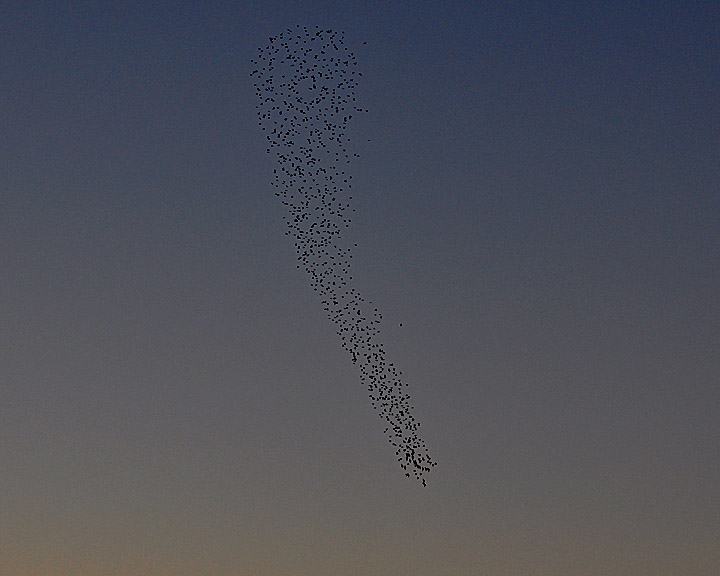

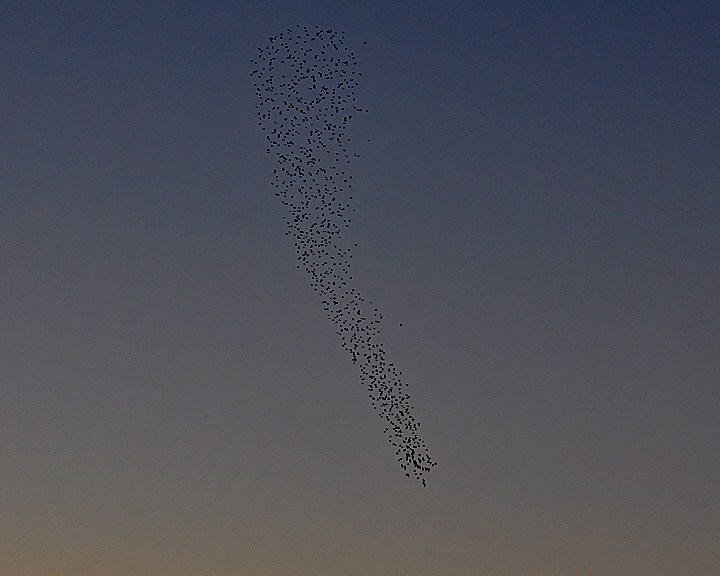
Watching a starling murmuration is something few would forget. While not in their thousands the starlings coming into roost at Kinnordy Loch are well worth a visit. This particular evening a few birds first swooped in over the back of the hide to be joined by others till then numbered about a thousand - I didn't count them. They dutifully performed their aerial ballet for me before swooshing down to the reeds. The sound of their wings as they come into land is beautiful. My photos don't do it justice.


What is a Murmuration?

Regularly through the autumn starlings gather in huge flocks whirling and dipping in the sky in formations that confound the eye. Some think they gather in murmurations to attract other starlings, safety in numbers before they roost for the night. They are called murmurations after the sound made by hundreds of bird's wings and calls. 

They typically pick reed beds to roost in and it is thought they gather like this to confuse predators; in tightly spaced acrobatics it is more difficult to pick out their prey although a murmuration is itself a target for birds of prey. When one appears the ball of birds becomes ever denser. Moving swiftly, they can fly up to 50 miles an hour, and constantly changing direction and shapes confuses the hunters. 

There doesn't seem to a single bird direction operations instead it appears those in the centre see what is happening around them and follow. They constantly change position in the flock, the edges becoming the middle and back again. This may be a way of determining the strongest. When they suddenly swoop down to roost it is the strongest who come in last. They get to roost at the top of the reed while those above them must put up with their droppings. 

Good Resources 

Following are good resources to check out if you want to know more about starling murmurations and see some spectacular videos. 

The Science of Murmurations

RSPB

Starling Murmuration Facts

Murmuration with Sound


Tuesday, 2 October 2018

2018!


OK so I haven't been here for a while, only just realised it has been 2 YEARS! Yikes. Well just to let you know having spent time listening to David Lindo at Ilkley Literature Festival this weekend, it is time to dust off the camera and get clicking. If you don't know David Lindo is The Urban Birder of TV fame and is certainly an inspiration. OK - I'm may be a little biased since he used one of my photos of a herring gull in St Andrews fairly recently.
Sooo watch this space!....

https://theurbanbirder.com/

Sunday, 17 January 2016

More Gannets at RSPB Bempton Cliffs

SAVE BEMPTON CLIFFS FROM FRACKING!

Photo journal of the Gannet colony at RSPB Bempton Cliffs, Yorkshire

IF YOU DON'T WANT TO LOSE THIS NATURE RESERVE YOU NEED TO TAKE ACTION NOW - SIGN THE PETITION TO STOP FRACKING AT BEMPTON CLIFFS

 - AND PASS IT ON TO YOUR FRIENDS. 

http://action.sumofus.org/a/SSSI-fracking/2/4/


I am republishing this as a protest against the decision to allow fracking in  this area - PLEASE HELP 

Gannets with Chicks at RSPB Bempton Cliffs
I can't see too many pictures of gannets - they are so elegant and so charismatic they are hard to resist. So - Here are more beautiful original photographs of nesting North Atlantic Gannets . Follow the gannet's progress and wonder at the many displays of affection these elegant birds take part in.

Tuesday, 25 August 2015

Pictures of Birds: The Grey Heron

The Grey Heron in Words and Pictures


They may not be my favourite birds, especially when they are snapping up my ducklings and goslings, but there is no doubt the Grey Heron is a striking bird - This photo journal showcases some stunning photographs of The Grey Heron, scientific name -Ardea cinerea.
The grey heron is a common sight along England’s rivers and canals. A big bird, it stands around three to four feet tall when its neck is extended. It can retract the neck both while standing and always does so in flight. The heron has an impressive wing span of five to six and a half foot and tend to keep them bowed when flying. Indeed it has a slow, steady and very deliberate looking wing beat, one of the slowest of the bird family. Most adult herons weigh in anywhere between 2 and 5 pounds.
Both genders look alike being mostly grey with lighter greyish white underneath. The adults have a white crown and forehead with black on each side of the head. These tail into long feathers that are often hard to see except when the bird is in threatening or courting stance. The long neck is black and white and the wings grey with white ‘shoulders’ and black edges . Herons have very long strong, actually wicked-looking beaks. In winter they are yellowish with a black tip but during the breeding season are bright orange as this one seen here. You may also note the orange ‘flushes’ on otherwise grey or yellowish legs. This flush will also disappear once the breeding season is over.
This particular bird is quite striking when see from the front. One couldn’t help comparing him to someone in a Halloween costume with a skeleton painted on him. He stands purposefully, his legs almost braced ready to leap from stillness to action in a second. It is this stillness that is the heron’s hallmark characteristic. It is possible to miss spotting them standing perfectly still either on the bank or in shallow water. They show infinite patience and unwavering concentration in waiting for prey to step close enough for them to snatch. You can also see them stalking as smoothly as any cat. They take slow strides on those long legs without stirring the water or alerting their victim. Herons feed mainly on fish but will take frogs and young chicks.
It is always rather alarming to see a heron during the breeding season and this one was very definitely on the hunt. It was first spotted when some geese, including some Canada geese were making a noise close to a couple of nests. It was easy to see what had alarmed them but the combined noise seemed to set it to flight. It took off down the canal, stopping next on the opposite bank across from where there are some domestic fowl being kept. He watched intensely for several minutes before turning his attention back to the canal, perhaps deciding he had little chance in the allotments.


He flew over to the far bank , stood still then started a slow paced stalk towards where there is a moorhen’s nest but was out of luck there too. I was just in time to catch him taking off and followed him down the canal where I found him standing on the edge of the canal, outside some apartments. He had spotted our little white hybrid mallard duck and her thirteen ducklings. Mallard ducklings are easy meals for herons as they tend to busily swim far and wide around the mother instead of sticking close to her side as goslings do to their adults. Fortunately he missed out this time too.


2014

Along Bingley canal the ducklings and new chicks are having a bad year and one of the reasons for that is the constant presence of grey herons. Herons feed mainly on fish but will also take small birds and frogs.
It easy to miss them when you are out walking as they stand so still. You are first likely to spot them standing statue-like on the edges of water, often in reed beds such as this one pictured here. They can stand still for long periods of time and do so, waiting and watching for prey to come within reach. Those striking yellow eyes miss nothing.
Rather than stab, that long thin beak is used to snatch. It must also come in very handy for preening as you will see later in this little photo diary.

Posing Herons


Herons are quite stately birds. They can stretch out that long neck so they reach their full height of around 4 foot, or they can hunch down, the neck almost disappearing between the shoulders. They typically have 20 vertebrae making up the neck.
With hunched back, they remind me of vultures. These birds look almost pre-historic and it is no surprise that fossils of them have been found going back millions of years. The fossils are not common probably because of the fragility of the bone structure but they have been found and dated back 60 million years.

How Herons Fish

Herons stand motionless in shallow water. On bright days they prefer to be in shadow, in places where fish go and where the fish will not see them. Like any angler, patience is their strongest ally. At times they stalk very slowly along the edges of the water, raising one long leg high and slowly placing it down careful so they cause no ripples to betray their presence.
Once it has spotted its prey, the heron slowly lowers its head to within touching distance of the water, again, taking care not to scare the fish away. Then, suddenly, as quick as a flash, it will strike and catch the fish in that sharp beak. It is snatched rather than speared and disappears, head first, quickly down that long gullet.

Preening Heron

Feathers need taking care of, so like any bird it is common to see herons preening. They must have an advantage with that long beak. They have an oil gland near the base of the tail that it can take oil from with its beak. Then it uses the beak to preen the feathers to repair damage and to keep them waterproof with the oil.
They also have what are called powder feathers on their chest that create a powder or dust from them to clean up with. A lot of their food, for example frogs, are slimy and the powder helps to soak up the mess.
They are also quite adept at scratching with a long toe to get rid of parasites and distribute the oil. Indeed, the central toe has a serrated claw to help preening.

Facts about Herons

  1. Herons nest high in trees in colonies called heronries.
  2. They return to the same nest year and year, just adding onto it so it eventually can measure several feet across.
  3. They lay about five eggs that hatch in about 25 days.
  4. Both parents feed the chicks by regurgitation.
  5. The chicks won't fledge for 50 days.


Heron's in flight

As they are taking to the air, heron's stretch out that long neck but it is soon drawn back into the body, the better to protect it. They have a huge wingspan of around 6 feet and typically fly with bowed wings. They stretch out their long legs steam-lined behind them in flight. For such a big bird they are surprisingly agile in the air and are capable of sudden twists and dives.


Tuesday, 5 May 2015

Visiting Loch Leven 4th May

Loch Leven Kinross Journal

tufted ducks
Tufted ducks at Loch Leven
Visiting Loch Leven nature reserve - day one. I'm lucky enough to be spending a couple of weeks house and pet sitting in Milnathort near Kinross so I'm in easy reach of Loch Leven  so I thought this was the perfect opportunity for me to write an ongoing journal.

Loch Leven in the old county of Kinross north of Edinburgh in Scotland. It is a huge loch stretching about 5 square miles and is maintained by The Scottish Natural Heritage and the RSPB. With a round the loch trial at 13-14 miles it is a wildlife haven for thousands of birds and with a bit of luck I'll be able to capture at least some of them on camera. 

Tuesday, 28 April 2015

Canada Geese and Goslings

Canada Geese and Goslings
adult canada geese and goslings
Canada Geese with 4 goslings
Early in April 2011 a pair of Canada geese were seen mating on Bingley canal. The female duly made her nest on the bank and laid eggs. She was very well hidden although the nest was very close to the water and often all that could be seen was the top of her black head. If you didn't know to look, you would never have seen her. What gave away the location of the nest was the patrolling presence of the male on the canal. He never left, keeping careful watch and chasing away all and sundry. The only one they has trouble with is Grumps the mute swan who thinks he is king. This is a photo diary of the story of a Canada goose's nest and the arrival of goslings
.

Friday, 17 April 2015

Hard at Work Starling

Starling photos at Upton

starling on bird feeder
starling trying to figure out how to get to the fat balls in the feeder

This little lad looked a bit disgusted that he had to work hard to reach the fat balls on the feeder. Just shows how handy that long beak is.

Starlings are surprisingly beautiful birds - just look at those luminescent feathers!

They tend to get a bad press. They are a bit noisy and they like to go around in flocks. They are particularly good to watch at Upton Cottage with young families when they fledge. They nest at the house which gives us a great chance to see them.

starling on bird feeder
"it WILL be mine!"
starling on bird feeder
'fluttering' starling on bird feeder


starling on bird feeder

starling on bird feeder
'Triumphant!' starling on bird feeder

Tuesday, 14 April 2015

The Lucky Pigeon


Normally pigeons don't get to feed from hanging bird feeders - they are too heavy to perch which is the general idea - to keep them away so the small birds get a chance. Yesterday I glanced up to see this clever fella had taken advantage of the fact I had hung one feeder too close to a table so he got his chance to graze.

Pigeon at bird feeder

Pigeon at bird feeder

Pigeon at bird feeder

Pigeon at bird feeder


Saturday, 14 March 2015

Goldie the White Mallard Duck with her Ducklings

white mallard duck with ducklings
Goldie the white mallard duck with her ducklings

White Female Mallard Duck shows off her new Ducklings


This photo journal features a little white duck with her ducklings. The white duck is a mallard duck. It isn't unusual for mallard ducks to have unusual colourings, probably the result of centuries of inter-breeding.
Last year, a light-coloured female mallard appeared with a brood of 15 ducklings. Twelve were ordinary looking mallard ducklings, two were lighter in colour and one was golden yellow. She became 'Goldie' in a children's photo book I produced last year and she grew into a beautiful white duck.

This year, Goldie has produced her own ducklings. There are twelve of them and seven have inherited her white gene: presently they are tiny balls of yellow fluff who will also turn white as they mature. This page records the first appearance of 'Goldie' with her new ducklings.

Sunday, 8 March 2015

St Andrews Seagull

Clever Seagull Begs for Food

young girls feeding seagull Market Street St Andrews Fife Scotland
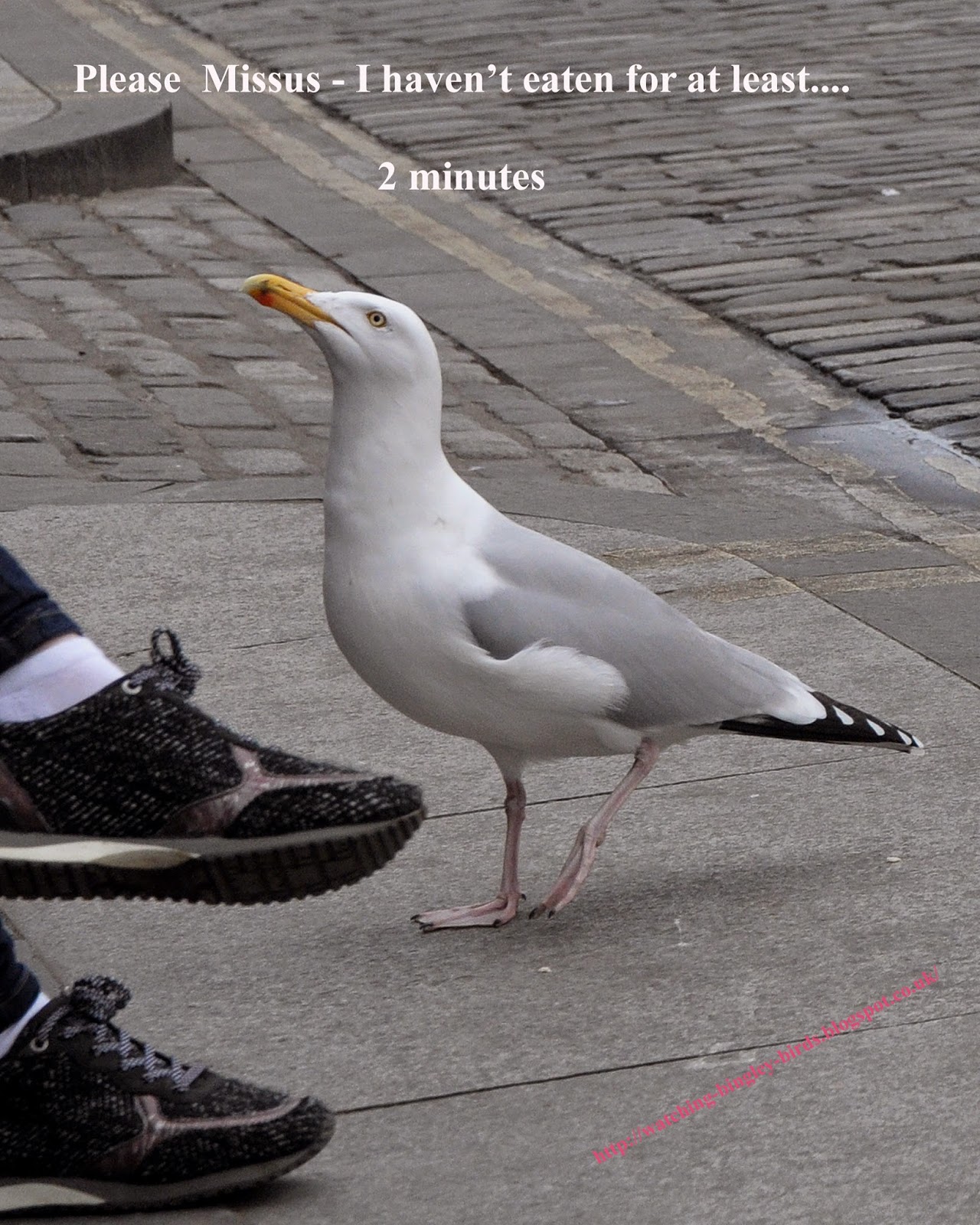
Visiting St Andrews I was kept amused by this clever seagull in Market Street begging for then catching food. Hope you enjoy the pictures.

The Perfect Catch a poem by AnnMackieMiller


Feet in constant motion
like a fielder on a baseball  pitch
he shuffles back and forth
eyes steady
always ready
the throw leaves the hand
and wham
his head whips round
and bam
the perfect catch


young girls feeding seagull Market Street St Andrews Fife Scotland
seagull begging for food

young girls feeding seagull Market Street St Andrews Fife Scotland
seagull catching food thrown for it - he never missed!

seagull being fed
seagull catching bread thrown for it

young girls feeding seagull Market Street St Andrews Fife Scotland
seagull begging for food

seagull
lunch over

The Perfect Catch a poem by AnnMackieMiller


Feet in constant motion
like a fielder on a baseball  pitch
he shuffles back and forth
eyes steady
always ready
the throw leaves the hand
and wham
his head whips round
and bam
the perfect catch

Monday, 9 February 2015

Pictures of British Birds: The Coot

Meet the Coot  

british birds the coot
Female Coot on water
Coots are one of my favourite water birds so it was a joy to make this page to share my pictures. I've included some interesting information and facts you might enjoy including how they take off into flight and how they attack or defend themselves.  If you like my pictures, please feel free to share the link but the photos are copyright to me. Thanks. 

Wednesday, 21 January 2015

Mr & Mrs Blackbird on the Coconut

Pictures of Male and Female Blackbirds on Feeder

Winter Feeding Wild Birds
Male Blackbird on coconut feeder

Female Blackbird on coconut feeder
female Blackbird on coconut feeder
No bird behaviour post today - just a couple of pictures of Mr and Mrs Blackbird enjoying the coconut in the garden yesterday and a reminder to keep feeding them.  At this time of year it is as well to remember to put out some fat for them so they can generate their own heat! Suet balls and slabs, coconut half shells - I keep mine when they are empty and fill them with bird peanut butter that you can buy at pet stores on online  - don't be tempted to use human peanut butter - I don't think it is good for them but I could be wrong.

Take the suet balls out of the net and break it up for ground feeders. I tend to just throw one on the ground and the blackbirds love to peak at it.

You can also make your own of course - RECIPES FOR HOMEMADE SUET


AND don't forget to put out water for them!